Quick-Harvest Guide
How to Grow Green Onions (Scallions and Spring Onions)
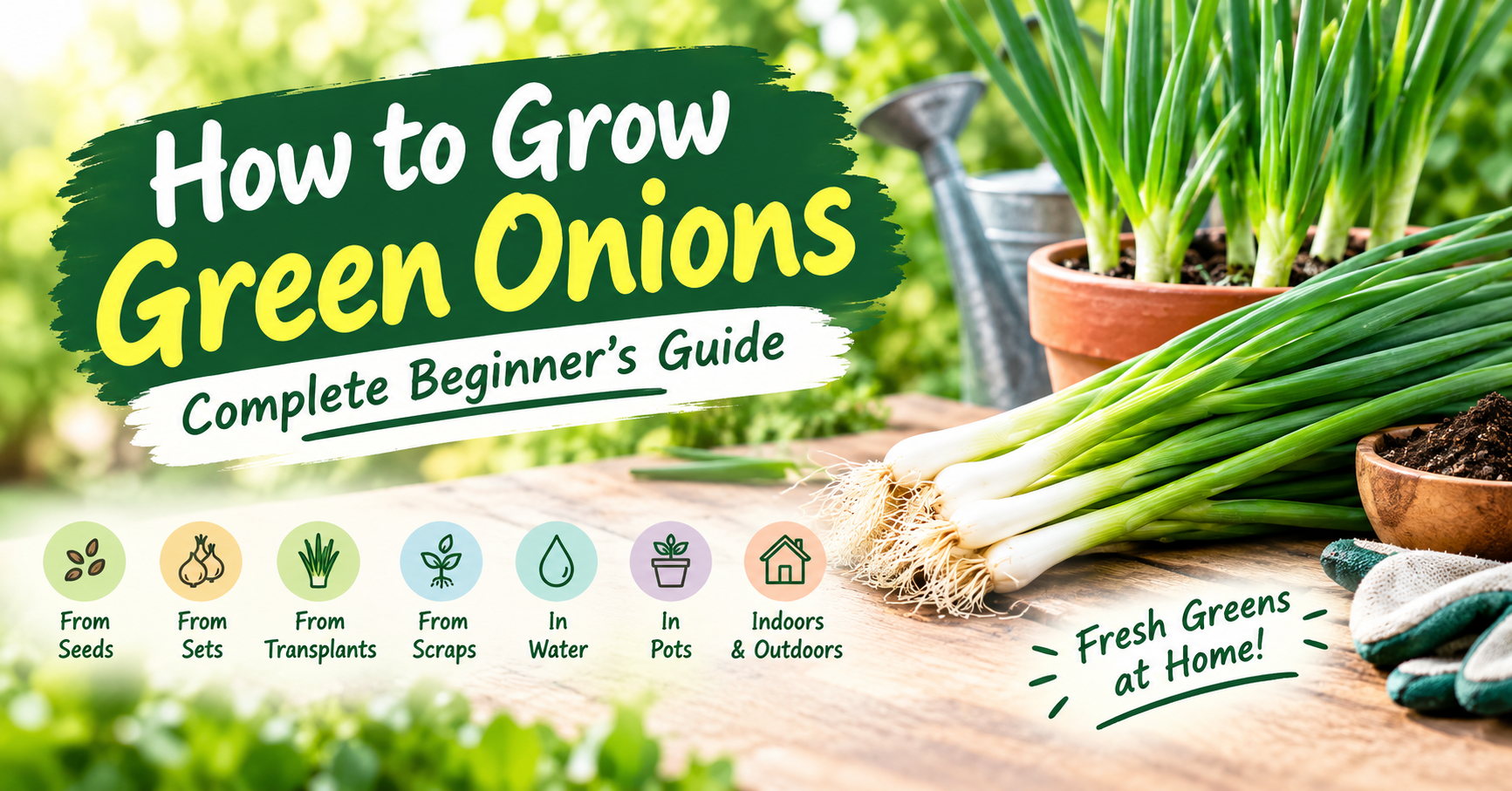
Green onions are ready in roughly 25 to 80 days depending on how you start them — one of the quickest harvests in the whole onion family. This guide covers how to grow green onions from seed, sets, transplants or kitchen scraps: sow or plant them 2 to 3 inches apart in full sun and loose soil, and pull them once the tops reach about 6 inches tall, well before any bulb has time to form.
Green Onions at a Glance
| Quick Fact | What to Know |
|---|---|
| Time from seed | About 25 to 80 days |
| Sowing depth | Seed about ¼ inch deep; sets just below the surface |
| From a bulb-onion bed | Plant 2 to 3 inches apart; pull every other plant once tops reach about 6 inches |
| Sun | Full sun — 6 or more hours a day |
| Soil | Loose, well-drained and compost-enriched |
| Soil pH | 6.0 to 6.8 |
| Feeding | A light nitrogen-rich liquid feed every 2 to 4 weeks in fast growth |
| Indoors | Greens only, unless you give them strong grow lights |
Scallion vs. Green Onion vs. Spring Onion: What’s the Real Difference?
These three names get used almost interchangeably, and sources don’t fully agree on where to draw the line. University of Kentucky Extension describes true scallions as lacking bulb formation entirely, with spring onions having a more developed bulb, and notes the terms are often mixed up in casual use.
Illinois Extension draws it similarly: true scallions have no bulb, while green or spring onions have a small 1 to 2 inch bulb. Harvest to Table adds that in the UK and Australia, “green onion” and “spring onion” usually mean exactly the same thing. For a home grower, the practical rule cuts through all of it: the longer you leave the plant in the ground, the bigger the base gets — pull early for a scallion-style straight stem, or let it sit longer for a more developed bulb. For a complete side-by-side comparison, see scallion vs spring onion vs green onion — the full difference.
How to Grow Green Onions From Seed, Step by Step
- Pick your type first. True bunching varieties (Allium fistulosum) never form a bulb, so they stay at green-onion size however long you leave them. Ordinary bulbing onions (Allium cepa) work too, but only as a young harvest — leave them in and they swell into bulbs. If you want a plant-it-and-pick-for-months crop, start with a bunching variety (the named varieties are covered below).
- Prepare a loose, fed bed. Green onions are shallow-rooted and poor competitors, so weeds and heavy soil cost you more here than with most crops. Work compost into the top few inches of a well-drained bed in full sun, aiming for a soil pH of 6.0 to 6.8. Where soil drains slowly, a raised or mounded bed keeps the roots out of standing water.
- Sow shallow — about ¼ inch deep. Sow seed roughly 1 inch apart in rows and cover with about ¼ inch of fine soil. Oregon State University Extension puts the outdoor starting point at a soil temperature of at least 50°F; the same guidance starts seed indoors 8 to 10 weeks before the planting date if you want transplants instead. Either way, keep the surface evenly moist from sowing onward — a dried-out seedbed is the commonest reason a sowing fails.
- Expect seedlings in 7 to 14 days. Onion seed is slow and a little patchy compared with radish or beans, so do not give up on a row at day five. Burpee’s scallion guidance puts emergence at 7 to 14 days; keep watering little and often while the seedlings — thin as green hairs at first — establish.
- Thin to 2 to 3 inches, and eat the thinnings. Once seedlings are a couple of inches tall, thin them to a final spacing of 2 to 3 inches. The thinnings are your first harvest, and the plants left behind size up noticeably faster without the crowding.
- Succession-sow every 2 to 3 weeks. A short row every 2 to 3 weeks through spring and summer keeps green onions arriving steadily instead of all in one glut — Harvest to Table recommends the same 2-to-3-week rhythm for a continued harvest.
From sets or transplants instead: plant sets just below the soil surface, 2 to 3 inches apart, and you will be cutting green tops within a few weeks. Sets planted in fall can go in 2 to 4 inches deep under a mulch for an early spring harvest. Transplants from an indoor sowing go out at the same 2 to 3 inch spacing, at the depth they were growing in the tray.
Three Ways to Grow Green Onions, Compared
Green onions reach the kitchen by three different routes, and the right one depends on how fast you want them and what you already have. Seed is the classic crop and the cheapest per plant; sets and transplants trade a little money for a few weeks’ head start; kitchen scraps are free and fast for greens, but they are a top-up, not a crop. The table below puts the three side by side — the sections that follow cover each route in full.
| Method | You start with | First harvest | Depth | Best for |
|---|---|---|---|---|
| From seed (bunching varieties) | Seed of Allium fistulosum | 60–80 days | Sow about ¼ inch deep, ~1 inch apart; thin to 2–3 inches | The classic crop — cheapest per plant, widest variety choice, perennial clumps |
| From sets or transplants | Bulbing-onion sets, or seedlings started indoors | A few weeks from planting | Sets just below the soil surface; transplants at tray depth | Speed, and filling gaps in spring |
| From kitchen scraps | Root ends of store-bought green onions | New tops in 1–2 weeks | Root end about 1 inch deep in soil, or roots in water | Free plants and windowsill greens — a top-up, not a crop |
If you only ever pick one, pick seed of a bunching variety: it is the only route that gives you the perennial, divide-and-replant patch described below, and it is the only one where you choose the variety rather than taking what the store had.

Watering and Feeding Green Onions
Green onions live on the top few inches of soil. Their roots are shallow, so that layer has to stay evenly moist from sowing to harvest — Oregon State University Extension’s bunching-onion advice is simply to water enough to keep the soil evenly moist, and Harvest to Table adds the technique: water often but lightly, at soil level, and avoid wetting the foliage, which invites disease. As a working target, Epic Gardening aims for about 1 inch of water a week, and more often in sandy soil or pots, which dry out fastest.
A mulch of compost or grass clippings around the plants holds that moisture in, keeps weeds down, and feeds the soil as it breaks down. Weed by hand or with a shallow hoe — deep cultivation tears the roots you are trying to feed.
Feeding. The harvest is the leaf, so feed for leaf growth. A light nitrogen-rich liquid feed — fish emulsion is the classic choice — every two weeks while the plants are growing fast suits most beds. In rich, compost-fed soil, Harvest to Table’s slower cadence of every three to four weeks is enough. Green onions are a 50-to-70-day crop, so there is no long feeding programme to manage: two or three light feeds across the crop’s life is the whole job.
Which Green Onions to Grow: Bunching Varieties vs Bulbing Onions Cut Young
Two different plants hide behind the name “green onion,” and the choice decides how your patch behaves.
True bunching onions (Allium fistulosum) never form a bulb — Burpee notes of its ‘Evergreen Long White’ bunching type that it never forms a bulb and can be pulled individually or as a bunch, and the same holds across the type. They are perennials, hardy in about USDA zones 6 to 9, and left in the ground they divide slowly into clumps. The University of Massachusetts Extension vegetable guide lists three scallion/bunching varieties for its region — ‘Deep Purple’ (the red-skinned one), ‘Evergreen Hardy White’ and ‘Parade’ — and Epic Gardening’s growers also rate ‘Tokyo Long White’, ‘White Lisbon’ and ‘Heshiko’. Any of these is a sound first sowing.
Bulbing onions (Allium cepa) cut young are the second route: any bulbing variety, harvested before the bulb swells, eats exactly like a green onion — it is the “spring onion” end of the scale covered in the names section above. The trade-off is that the patch is a one-season crop, and a plant you pick from will not go on to make a storage bulb.
Keeping a patch for years. Bunching onions earn their keep in year two. Leave a few clumps unharvested and they die back in winter and reappear in spring; lift and divide crowded clumps, and replant the divisions at the usual 2 to 3 inch spacing to start a new patch for free. For a winter harvest in cold areas, Harvest to Table’s method is to sow in late summer or early fall, let the seedlings establish, then protect them through winter with mulch or a low tunnel.
Growing Green Onions From an Existing Bulb-Onion Bed
If you’re already growing bulb onions, you don’t need a separate bed for green onions. Illinois Extension’s approach: plant or thin to about 2 to 3 inches apart, then simply pull every other plant once the tops are about 6 inches tall. The remaining plants keep growing undisturbed and go on to form full bulbs at normal spacing.
Growing Green Onions From Scraps or Cuttings (in Soil)
You can regrow green onions in soil from the root end you’d normally throw away. Save the white base with about an inch of root attached, plant it root-down in loose, moist soil with the cut top left exposed, and keep it watered and in full sun. New growth usually appears within one to two weeks, and most bases can be cut and regrown two to three more times before the stored energy runs low and shoots start coming in noticeably thinner.
This soil method tends to produce sturdier, longer-lasting regrowth than the water-glass method, since the plant can access real nutrients from the soil rather than just what you add to the water. If you’d rather watch roots develop before committing to soil, see our dedicated guide to growing green onions in water.


Growing Green Onions Indoors
A bright windowsill can keep green onions going for kitchen use, but Dixondale Farms advises against growing bulb-forming onions indoors without a grow light — a windowsill alone gives you greens, not properly sized bulbs, because the light intensity simply isn’t enough. If you’re only after a steady supply of green tops for cooking, a sunny window is usually enough; if you want anything resembling a real bulb, you’ll need supplemental grow lights and should expect container-growing results rather than true indoor growing.
Harvesting Green Onions and Storing the Surplus
When to pick. Pull whole plants once the tops are about 6 inches tall and the stem is roughly pencil-thick — the harvest size given by UTHealth Houston’s garden data and by Harvest to Table. Loosen the plant with a trowel rather than pulling on the top; the stems snap easily, and a snapped plant is a wasted one.
Cut-and-come-again. For greens only, snip the tops 1 to 2 inches above the base and leave the roots and white shank in the ground — Epic Gardening’s method for a continual harvest from the same plants. The regrowth is thinner than the first cut, so treat a plant to two or three cuts and then let the succession sowing take over.
Storing the surplus. Fresh green onions keep for about a week in the refrigerator. Harvest to Table’s storage method: stand the root ends in a jar with a little water and slip a plastic bag over the tops to hold the humidity, changing the water if it turns murky. Cut tops keep best wrapped in a paper towel inside a bag — Epic Gardening notes that excess moisture is what shortens their storage life.
Frequently Asked Questions
How long does it take to grow green onions from seed?
About 60 to 80 days after planting to a harvestable green onion.
How deep do you plant green onion seeds?
About ¼ inch deep, sown roughly 1 inch apart. Keep the soil evenly moist, expect seedlings in 7 to 14 days, then thin to 2 to 3 inches — and eat the thinnings.
When should you start green onion seeds indoors?
About 8 to 10 weeks before your planned planting date. Outdoors, sow as soon as the soil can be worked in spring and has warmed to about 50°F.
Is a scallion the same as a green onion?
Often, in practice. Strictly, scallions have no bulb at all, green onions have a slight bulb, and spring onions a rounder one — but usage varies by country and store, so don’t worry too much about the label.
What are the best green onion varieties to grow?
True bunching varieties that never form a bulb. The University of Massachusetts Extension vegetable guide lists ‘Evergreen Hardy White’, ‘Parade’ and the red-skinned ‘Deep Purple’ as its scallion varieties; ‘Tokyo Long White’ and ‘White Lisbon’ are other widely grown bunching types.
Can you grow green onions from scraps?
Yes. Save the white rooted ends — in soil, plant the base root-down in loose, moist soil with the cut top exposed; in water, stand it in a glass with the roots covered. Either way it can produce new green growth, although soil is generally better for continued production. Most bases can be cut and regrown a few times before vigor declines and shoots come in thinner.
Can green onions grow in water?
Yes. Rooted green onion ends can regrow in water. Keep the roots in water, provide good light, and change the water every 2 to 3 days. For longer-term growth, moving them into soil gives access to more nutrients. (Our separate guide to growing green onions in water covers the method step by step.)
Do green onions need full sun?
Green onions grow best with plenty of light — full sun, 6 or more hours, outdoors. Indoor plants need a sunny window or supplemental grow lighting when natural light is insufficient.
Can you grow green onions in pots?
Yes. Green onions are well suited to containers. Use a pot with drainage holes, a quality potting mix, adequate moisture, and sufficient light.
Do green onions grow back after cutting?
They can. Healthy plants continue producing new leaves after harvesting, as long as you leave the growing point and roots intact. Avoid repeatedly removing all the growth from a weak plant.
Do green onions come back every year?
True bunching onions (Allium fistulosum) do — they are perennials, hardy in about USDA zones 6 to 9, that die back in winter, reappear in spring and slowly divide into clumps you can split and replant. Green onions grown from bulbing-onion sets are a one-season crop.
Can you grow green onions indoors all year round?
Yes for greens: a bright windowsill works year-round, though growth is thinner than outdoors and a grow light gives more consistent results through winter. Outdoors, succession planting — sowing in batches every 2 to 3 weeks — plus staggered containers keeps the supply going as long as your climate allows.
What is the best soil for green onions?
Fertile, loose, well-drained, compost-enriched soil, or a quality vegetable potting mix. Good drainage matters because constantly saturated soil can damage roots.
Why are my green onions so thin?
Thin growth can result from insufficient light, overcrowding, poor nutrition, inconsistent moisture, or simply the characteristics of the variety. Check growing conditions before assuming fertilizer is the solution.
How often should you fertilize green onions?
Little and often. A light nitrogen-rich liquid feed every two weeks while they are growing fast suits most beds; in rich, compost-fed soil, every three to four weeks is enough. The harvest is the leaf, so nitrogen is the nutrient that matters most.
Can I grow green onions without seeds?
Yes. You can use onion sets, transplants, or rooted green onion scraps. The best option depends on whether you want a quick experiment, a convenient planting method, or reliable long-term production.
How do you harvest green onions without killing them?
Harvest selectively rather than removing everything at once. Snip the green tops or pull individual outer leaves as needed, leaving healthy growing tissue and roots intact, and the plant keeps producing.
How long do green onions keep after harvest?
About a week in the refrigerator. Stand the root ends in a jar with a little water and slip a plastic bag over the tops to keep them crisp; if the water turns murky, change it for fresh.
Final Thoughts
Green onions are the fastest reward in the whole onion family: sow or plant every few weeks, harvest in roughly 25 to 80 days, and don’t worry too much about whether you call it a scallion or a spring onion. For a completely different, zero-soil way to regrow them from kitchen scraps, see growing green onions in water, or head back to the how to grow onions guide for bulb onions.
How This Guide Was Checked
The growing figures in this guide were checked against Oregon State University Extension’s bunching-onion guidance and the University of Massachusetts Extension vegetable guide, the sowing depths and seedling timings against Burpee, and the scallion, spring onion and green onion definitions against Illinois Extension and Harvest to Table. The indoor-growing guidance follows Dixondale Farms’ advice on light requirements. Where sources draw the line between the three names differently, we say so rather than picking one silently. Spot a mistake? Contact us and we’ll correct it.
Related Onion-Growing Guides
- How to Regrow Green Onions in a Glass of Water
- Scallion vs Green Onion vs Spring Onion: What’s the Difference?
- How to Grow Onions in Pots and Containers
See the full How to Grow Onions guide for the complete seed-to-harvest walkthrough.

Written by Kevin Parker · grows onions in his own beds in California. Figures are checked against university extension and grower sources, linked on each page. More about Kevin.


